The MicroPython Core Runtime
This chapter details the core components that makeup MicroPython including the compiler, Memory Management, known optimizations, core and dynamic models and a summary of what happens when you run a MicroPython program.
For purposes of this chapter, the location of focus is the py
directory.
The compiler
The compilation process in MicroPython involves the following couple of steps:
- The lexer converts the stream of text that makes up a MicroPython program into tokens.
- The parser then converts the tokens into abstract syntax (parse tree).
- Then bytecode or native code is emitted based on the parse tree.
Changing the grammar
MicroPython’s grammar is based on the old CPython grammar
and is defined in py/grammar.h. This grammar is what is used to parse MicroPython source files.
There are two functions you need to know to define a grammar rule i.e DEF_RULE or DEF_RULE_NC.
DEF_RULE allows you to define a rule with a compile function.
A simple grammar definition with a compile function looks like the following:
DEF_RULE(add1_stmt, c(add1_stmt), and(2), tok(KW_ADD))
The second argument c(add1_stmt) is the corresponding compile function that should be implemented
in py/compile.c for this rule.
The third important argument can be or or and. This specifies the number of nodes associated with a statement.
For example, in this case, our add1 statement is similar to ADD1 in assembly language. It takes one numeric argument
and adds 1 to it. Therefore, the add1_stmt has two nodes associated with it. One for the statement itself
i.e add1 and the other for its argument.
Finally, the fourth argument in this example is the token associated with the rule. This token should be
defined in the lexer by editing py/lexer.h.
Defining the same rule without a compile function is achieved by using the DEF_RULE_NC function
and omitting the compile function argument:
DEF_RULE_NC(add1_stmt, and(2), tok(KW_ADD))
The remaining arguments take on the same meaning.
Note
The function DEF_RULE or DEF_RULE_NC takes other arguments. For an in-depth understanding
on what parameters are supported, see py/grammar.h.
Changing the lexer
Every rule defined in the grammar should have a token associated with it and defined in py/lexer.h.
Add this token by editing the _mp_token_kind_t enum:
typedef enum _mp_token_kind_t {
 ...
 ...
 P_TOKEN_KW_OR,
 MP_TOKEN_KW_PASS,
 MP_TOKEN_KW_RAISE,
 MP_TOKEN_KW_RETURN,
 MP_TOKEN_KW_TRY,
 MP_TOKEN_KW_WHILE,
 MP_TOKEN_KW_WITH,
 MP_TOKEN_KW_YIELD,
 MP_TOKEN_KW_ADD1,
} mp_token_kind_t;
Since, we are adding a keyword, edit py/lexer.c to add the new keyword:
STATIC const char *const tok_kw[] = {
 "False",
 "None",
 "True",
 "__debug__",
 "and",
 "as",
 "assert",
 #if MICROPY_PY_ASYNC_AWAIT
 "async",
 "await",
 #endif
 "break",
 "class",
 "continue",
 "def",
 "del",
 "elif",
 "else",
 "except",
 "finally",
 "for",
 "from",
 "global",
 "if",
 "import",
 "in",
 "is",
 "lambda",
 "nonlocal",
 "not",
 "or",
 "pass",
 "raise",
 "return",
 "try",
 "while",
 "with",
 "yield",
 "add1",
};
Notice the keyword is named depending on what you want it to be. For consistency, maintain the naming standard accordingly.
Note
The order of these keywords in py/lexer.h should match the order of tokens in the enum
defined in py/lexer.h.
Parsing
The parser takes the tokens produced by the lexer converting them to an abstract syntax tree(AST) or
parse tree. The implementation for the parser is defined in py/parse.c.
The parser also maintains a table of constants for use in different aspects parsing, similar to what a symbol table does.
Several optimizations like constant folding on integers for all operations i.e logical, binary, unary, etc, optimizing enhancements on parenthesis around expressions are performed during this phase and optimizations on strings.
Notable to the parser is that at this stage, some lonely statements like docstrings are discarded and not accessible to the compiler. Even optimizations like string interning are not applied to docstrings.
Compiler Passes
Like many compilers, MicroPython compiles all code to MicroPython bytecode or native code for
execution by the virtual machine. The functionality that achieves this is implemented in``py/compile.c``.
The most relevant method you should know
about is mp_raw_code_t *mp_compile_to_raw_code(mp_parse_tree_t *parse_tree, qstr source_file, bool is_repl).
The compiler compiles the code in several passes.
In the first pass, the compiler computes the stack sizes in scope:
// compile pass 1
comp->emit = emit_bc;
#if MICROPY_EMIT_NATIVE
comp->emit_method_table = &emit_bc_method_table;
#endif
uint max_num_labels = 0;
for (scope_t *s = comp->scope_head; s != NULL && comp->compile_error == MP_OBJ_NULL; s = s->next) {
     #if MICROPY_EMIT_INLINE_ASM
     if (s->emit_options == MP_EMIT_OPT_ASM) {
         compile_scope_inline_asm(comp, s, MP_PASS_SCOPE);
     } else
     #endif
     {
         compile_scope(comp, s, MP_PASS_SCOPE);

         // Check if any implicitly declared variables should be closed over
         for (size_t i = 0; i < s->id_info_len; ++i) {
             id_info_t *id = &s->id_info[i];
             if (id->kind == ID_INFO_KIND_GLOBAL_IMPLICIT) {
                 scope_check_to_close_over(s, id);
             }
         }
     }
..
}
Other computations regarding scopes and identifiers are computed but also at this point the number of labels that will be required in the emitted code is determined and set.
The second and third passes involve computing the code size and emitting the inline assembler code for
the different architectures:
// compile pass 2 and 3
#if MICROPY_EMIT_NATIVE
emit_t *emit_native = NULL;
#endif
for (scope_t *s = comp->scope_head; s != NULL && comp->compile_error == MP_OBJ_NULL; s = s->next) {
     #if MICROPY_EMIT_INLINE_ASM
     if (s->emit_options == MP_EMIT_OPT_ASM) {
         // inline assembly
         if (comp->emit_inline_asm == NULL) {
             comp->emit_inline_asm = ASM_EMITTER(new)(max_num_labels);
         }
         comp->emit = NULL;
         comp->emit_inline_asm_method_table = ASM_EMITTER_TABLE;
         compile_scope_inline_asm(comp, s, MP_PASS_CODE_SIZE);
         #if MICROPY_EMIT_INLINE_XTENSA
         // Xtensa requires an extra pass to compute size of l32r const table
         // TODO this can be improved by calculating it during SCOPE pass
         // but that requires some other structural changes to the asm emitters
         #if MICROPY_DYNAMIC_COMPILER
         if (mp_dynamic_compiler.native_arch == MP_NATIVE_ARCH_XTENSA)
         #endif
         {
             compile_scope_inline_asm(comp, s, MP_PASS_CODE_SIZE);
         }
         #endif
         if (comp->compile_error == MP_OBJ_NULL) {
             compile_scope_inline_asm(comp, s, MP_PASS_EMIT);
         }
     } else
The inline assembler code comprises assembly instructions in a Python function. See the inline assembler tutorial for more details.
The other two passes compute the stack and code size, while the last pass emits the final code:
compile_scope(comp, s, MP_PASS_STACK_SIZE);

if (comp->compile_error == MP_OBJ_NULL) {
     compile_scope(comp, s, MP_PASS_CODE_SIZE);
}

if (comp->compile_error == MP_OBJ_NULL) {
 compile_scope(comp, s, MP_PASS_EMIT);
}
Before these passes, there is a selection for the type of code to be emitted which can either be native or bytecode.
switch (s->emit_options) {

     #if MICROPY_EMIT_NATIVE
     case MP_EMIT_OPT_NATIVE_PYTHON:
     case MP_EMIT_OPT_VIPER:
         if (emit_native == NULL) {
             emit_native = NATIVE_EMITTER(new)(&comp->compile_error, &comp->next_label, max_num_labels);
         }
         comp->emit_method_table = NATIVE_EMITTER_TABLE;
         comp->emit = emit_native;
         break;
     #endif // MICROPY_EMIT_NATIVE

     default:
         comp->emit = emit_bc;
         #if MICROPY_EMIT_NATIVE
             comp->emit_method_table = &emit_bc_method_table;
         #endif
         break;
}
The bytecode option is the default but something unique to note for the native code option is that there is
another option via VIPER.
Emitting bytecode
For every statement in the code, there is a corresponding function to emit MicroPython bytecode.
This function should be written in py/emitbc.c. The implementation of this function looks similar
to this:
void mp_emit_bc_yield(emit_t *emit, int kind) {
     MP_STATIC_ASSERT(MP_BC_YIELD_VALUE + 1 == MP_BC_YIELD_FROM);
     emit_write_bytecode_byte(emit, -kind, MP_BC_YIELD_VALUE + kind);
     emit->scope->scope_flags |= MP_SCOPE_FLAG_GENERATOR;
}
We use the yield statement for an example here but the implementation details are similar for other statements.
The method emit_write_bytecode_byte() is a wrapper around the main function emit_get_cur_to_write_bytecode()
that all functions must call to emit byte code.
Emitting native code
Similar to how bytecode is generated, there should be a corresponding function in py/emitnative.c for each
code statement:
STATIC void emit_native_yield(emit_t *emit, int kind) {
 // Note: 1 (yield) or 3 (yield from) labels are reserved for this function, starting at *emit->label_slot

 if (emit->do_viper_types) {
     mp_raise_NotImplementedError(MP_ERROR_TEXT("native yield"));
 }
 emit->scope->scope_flags |= MP_SCOPE_FLAG_GENERATOR;

 need_stack_settled(emit);

 if (kind == MP_EMIT_YIELD_FROM) {

     // Top of yield-from loop, conceptually implementing:
     //     for item in generator:
     //         yield item

     // Jump to start of loop
     emit_native_jump(emit, *emit->label_slot + 2);

     // Label for top of loop
     emit_native_label_assign(emit, *emit->label_slot + 1);
 }

 // Save pointer to current stack position for caller to access yielded value
 emit_get_stack_pointer_to_reg_for_pop(emit, REG_TEMP0, 1);
 emit_native_mov_state_reg(emit, OFFSETOF_CODE_STATE_SP, REG_TEMP0);

 // Put return type in return value slot
 ASM_MOV_REG_IMM(emit->as, REG_TEMP0, MP_VM_RETURN_YIELD);
 ASM_MOV_LOCAL_REG(emit->as, LOCAL_IDX_RET_VAL(emit), REG_TEMP0);

 // Save re-entry PC
 ASM_MOV_REG_PCREL(emit->as, REG_TEMP0, *emit->label_slot);
 emit_native_mov_state_reg(emit, LOCAL_IDX_GEN_PC(emit), REG_TEMP0);

 // Jump to exit handler
 ASM_JUMP(emit->as, emit->exit_label);

 // Label re-entry point
 mp_asm_base_label_assign(&emit->as->base, *emit->label_slot);

 // Re-open any active exception handler
 if (emit->exc_stack_size > 0) {
     // Find innermost active exception handler, to restore as current handler
     exc_stack_entry_t *e = &emit->exc_stack[emit->exc_stack_size - 1];
     for (; e >= emit->exc_stack; --e) {
         if (e->is_active) {
             // Found active handler, get its PC
             ASM_MOV_REG_PCREL(emit->as, REG_RET, e->label);
             ASM_MOV_LOCAL_REG(emit->as, LOCAL_IDX_EXC_HANDLER_PC(emit), REG_RET);
             break;
         }
     }
 }

 emit_native_adjust_stack_size(emit, 1); // send_value

 if (kind == MP_EMIT_YIELD_VALUE) {
     // Check LOCAL_IDX_EXC_VAL for any injected value
     ASM_MOV_REG_LOCAL(emit->as, REG_ARG_1, LOCAL_IDX_EXC_VAL(emit));
     emit_call(emit, MP_F_NATIVE_RAISE);
 } else {
     // Label loop entry
     emit_native_label_assign(emit, *emit->label_slot + 2);

     // Get the next item from the delegate generator
     vtype_kind_t vtype;
     emit_pre_pop_reg(emit, &vtype, REG_ARG_2); // send_value
     emit_access_stack(emit, 1, &vtype, REG_ARG_1); // generator
     ASM_MOV_REG_LOCAL(emit->as, REG_ARG_3, LOCAL_IDX_EXC_VAL(emit)); // throw_value
     emit_post_push_reg(emit, VTYPE_PYOBJ, REG_ARG_3);
     emit_get_stack_pointer_to_reg_for_pop(emit, REG_ARG_3, 1); // ret_value
     emit_call(emit, MP_F_NATIVE_YIELD_FROM);

     // If returned non-zero then generator continues
     ASM_JUMP_IF_REG_NONZERO(emit->as, REG_RET, *emit->label_slot + 1, true);

     // Pop exhausted gen, replace with ret_value
     emit_native_adjust_stack_size(emit, 1); // ret_value
     emit_fold_stack_top(emit, REG_ARG_1);
 }
}
The difference here is we have to handle viper typing.
Memory Management
Unlike many programming languages such as C/C++, MicroPython hides memory management details from the developer by supporting automatic memory management (AMM). AMM is a technique used by operating systems or applications to automatically manage the allocation and deallocation of memory. This eliminates challenges such as forgetting to free the memory allocated to an object. AMM also avoids the critical issue of using memory that is already released. Automatic memory management takes many forms, one of them being garbage collection (GC).
The garbage collector usually has two responsibilities;
- Allocate new objects in available memory.
- Free unused memory.
There are many GC algorithms but MicroPython uses the Mark and Sweep policy for managing memory. This algorithm has a mark phase that traverses the heap marking all live objects while the sweep phase goes through the heap reclaiming all unmarked objects.
Note
The garbage collector automatically runs on the Linux port but may need to be manually enabled for other ports.
Garbage collection functionality in MicroPython is available through the gc built-in
module:
>>> x = 5
>>> x
5
>>> import gc
>>> gc.enable()
>>> gc.mem_alloc()
1312
>>> gc.mem_free()
2071392
>>> gc.collect()
19
>>> gc.disable()
>>>
Even when gc.disable() is invoked, collection can be triggered with gc.collect().
The object model
The structure of a MicroPython object is such that is takes up a word-size. That is to say, pointers and addresses take up a machine word of 8 bytes. Pointers can be 8, 16 or 64 bits.
********|********|********|********|********|********|********|********<tag><tag><tag>
In a 1 byte address, the 61 bits will hold a value while the 3 lower bits will hold a tag. This brings us to a concept that MicroPython supports that involves applying a tag to a pointer.
Pointer Tagging
More often than not the lower 3 bits of a pointer are zeroes i.e:
********|********|********|********|********|********|********|********000
These bits are reserved for purposes of storing a tag. A tag is a place holder that is used to store extra information as opposed to introducing a new field to store information usually in the object which may be inefficient.
The tags can store information like if we are dealing with a small integer, interned (small) string or a concrete object as different semantics apply to each of these.
For small integers the mapping is this:
********|..|******01
For a small or interned string:
********|..|******10
While a concrete object that is neither a small integer nor an interned string takes this form:
********|..|******00
Allocation of objects
Small integers take up 8 bytes and will be allocated on the stack and not the heap. This implies that the allocation of such integers does not affect the heap. Similarly, interned strings are small - usually less of a length less than 10 are stored as an array.
Everything else which is a concrete object is allocated on the heap and its object structure is such that we reserve a field in the object header to store the type of the object.
+++++++++++
+         +
+ type    + object header
+         +
+++++++++++
+         + object items
+         +
+         +
+++++++++++
The heap’s unit of allocation is a block that is to say the heap is further subdivided into blocks of 32 bytes. Another structure also allocated on the heap tracks the allocation of objects in each block. This structure is called a bitmap.
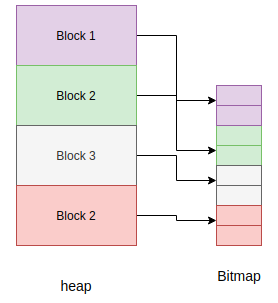
The bitmap tracks whether a block is “free” or “in use” and use two bits to track this state for each block.
The mark-sweep garbage collector manages the objects allocated on the heap. See py/gc.c for the full implementation of these details.
Writing Tests
Tests in MicroPython are written in the path py/tests:
.
 ├── basics
 ├── cmdline
 ├── cpydiff
 ├── esp32
 ├── extmod
 ├── feature_check
 ├── float
 ├── import
 ├── inlineasm
 ├── internal_bench
 ├── io
 ├── jni
 ├── micropython
 ├── misc
 ├── multi_bluetooth
 ├── multi_net
 ├── net_hosted
 ├── net_inet
 ├── perf_bench
 ├── pyb
 ├── pybnative
 ├── qemu-arm
 ├── README
 ├── run-internalbench.py
 ├── run-multitests.py
 ├── run-natmodtests.py
 ├── run-perfbench.py
 ├── run-tests
 ├── run-tests-exp.py
 ├── run-tests-exp.sh
 ├── stress
 ├── thread
 ├── unicode
 ├── unix
 └── wipy
There are subfolders maintained to categorize most tests. Add a test by creating a new file in one of the existing folders or in a new folder.
For example, add the following code in a file print.py in the Unix subdirectory:
def print_one():
 print(1)

print_one()
If you run your tests, this test should appear in the test output:
$ cd ports/unix
$ make tests
skip  unix/extra_coverage.py
pass  unix/ffi_callback.py
pass  unix/ffi_float.py
pass  unix/ffi_float2.py
pass  unix/print.py
pass  unix/time.py
pass  unix/time2.py
If you create a test under a new subfolder, be sure to update the test script run-tests.